I've spent way too many hours across the Call of Duty franchise, and I can tell you exactly where Modern Warfare 3 (2023) lost me. The single-player campaign felt less like a full sequel and more like a hastily stitched-together epilogue to Modern Warfare 2. Fans and critics noticed it almost immediately, and honestly, the disappointment hasn't faded even in 2026. When I compare it to the original Modern Warfare trilogy from over a decade ago, the differences are stark: the old games delivered high-stakes missions, memorable set pieces, and a narrative that respected the player's time and intelligence.
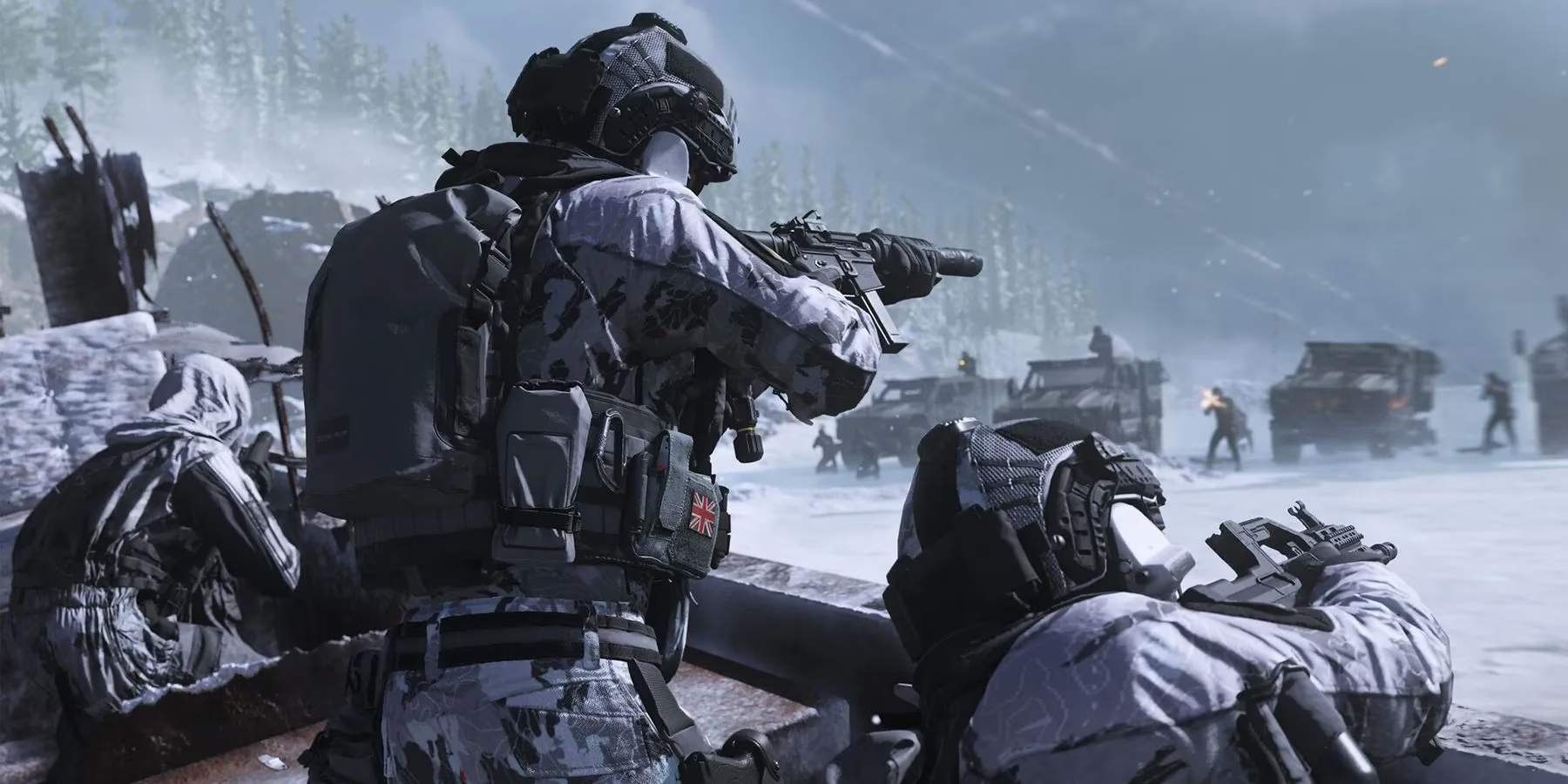
The vocal backlash wasn't just internet noise. A Bloomberg investigation revealed that Activision allegedly rushed Modern Warfare 3's development to fill a hole in its release calendar. Supposedly, a sequel to 2014's Advanced Warfare was delayed, so executives took a smaller Modern Warfare spinoff and rebooted it into a full Modern Warfare 2 sequel. That decision crushed the production window to roughly 16 months, which remains one of the shortest development cycles for a mainline Call of Duty title. For context, many previous entries had closer to three years of active development, so 16 months is brutal.
I think that crunch explains a lot about why the campaign felt so thin. According to Bloomberg's sources, more than a dozen current and former developers believed Modern Warfare 3 was originally planned as an expansion to Modern Warfare 2. Some were told directly it was an expansion; others said the plans were just ambiguous. When Activision later announced it as a standalone game, several team members at Sledgehammer Games felt betrayed. They had reportedly been promised they wouldn't have to endure another brutal short-cycle project after Call of Duty: Vanguard.
The result was a campaign I finished in a single evening. Most players can complete the story in five to eight hours, depending on difficulty and whether they hunt for collectibles. That is not necessarily a sin by itself, but the missions lacked the weight and variety I expect from a premium $70 release. TheGamingRevolution, a well-known Call of Duty content creator, called the writing poor and said it lacked tension, stakes, and originality. I agree. It felt like a highlight reel of concepts we already played in Modern Warfare 2, with reworked environments and a few new gadgets bolted on.
The backlash got so intense that some angry players review-bombed the original 2011 Modern Warfare 3. I find that a bit unfair, but I understand the frustration. It was a messy way to send a message: fans wanted a true sequel, not an expansion wearing a full-price costume.
Let me break down why I think players felt so let down:
-
Thin narrative: The story reintroduces Makarov but never gives him the terrifying presence he had in the original trilogy. Key emotional beats feel unearned.
-
Recycled mission design: Open Combat missions may have been intended to modernize the formula, but they often feel like empty sandboxes with reused assets.
-
Short runtime: Five to eight hours for a full-price campaign can feel underwhelming, especially when the original Modern Warfare games had tighter pacing but more memorable moments.
-
Developer burnout: Crunch and shifting goals create a rushed product. When developers are forced to pivot mid-production, quality suffers.
Here is a quick comparison I often think about:
| Feature | Original MW3 (2011) | MW3 (2023) |
|---|---|---|
| Campaign tone | Global stakes, emotional weight | Scattered, low tension |
| Mission variety | Set-piece driven, memorable | Repetitive open combat |
| Development context | Standard AAA timeline | Around 16 months |
| Player perception | Revered, classic | Divisive, rushed |
Now, in 2026, I still see players argue about whether Modern Warfare 3's campaign deserves a second chance. Some say it was never meant to be a full game, so judging it as one is unfair. Others say a full-price product should always meet full-price standards. I land somewhere in the middle. I appreciate that developers were put in an impossible position, but I also believe Activision should have been more transparent about what this campaign actually was.
The silver lining is that the multiplayer and Zombies modes carried a lot of goodwill at launch, but they don't erase the single-player disappointment. If Activision wants to regain the trust of story-driven Call of Duty fans, it needs to give future campaigns a realistic schedule, a clear vision, and enough time for developers to polish the experience. Otherwise, we might keep seeing talented studios forced to turn expansions into full-priced sequels, and that helps nobody.