I still remember that gut-wrenching moment in 2023, controller in hand, heart pounding, as I watched Vladimir Makarov put a bullet through Soap’s temple. The campaign finale of Call of Duty: Modern Warfare 3 had me assuming the role of Captain Price, bruised and pinned down, with nothing but a sidearm and a roaring desire for vengeance. But the game refused to let me pull the trigger in any meaningful way. Every shot I fired at Makarov as he strolled across the subway tracks simply vanished into the air. No hit marker, no grunt of pain—just silence. That was the day I learned my trigger finger could feel genuinely cheated by a narrative decision.
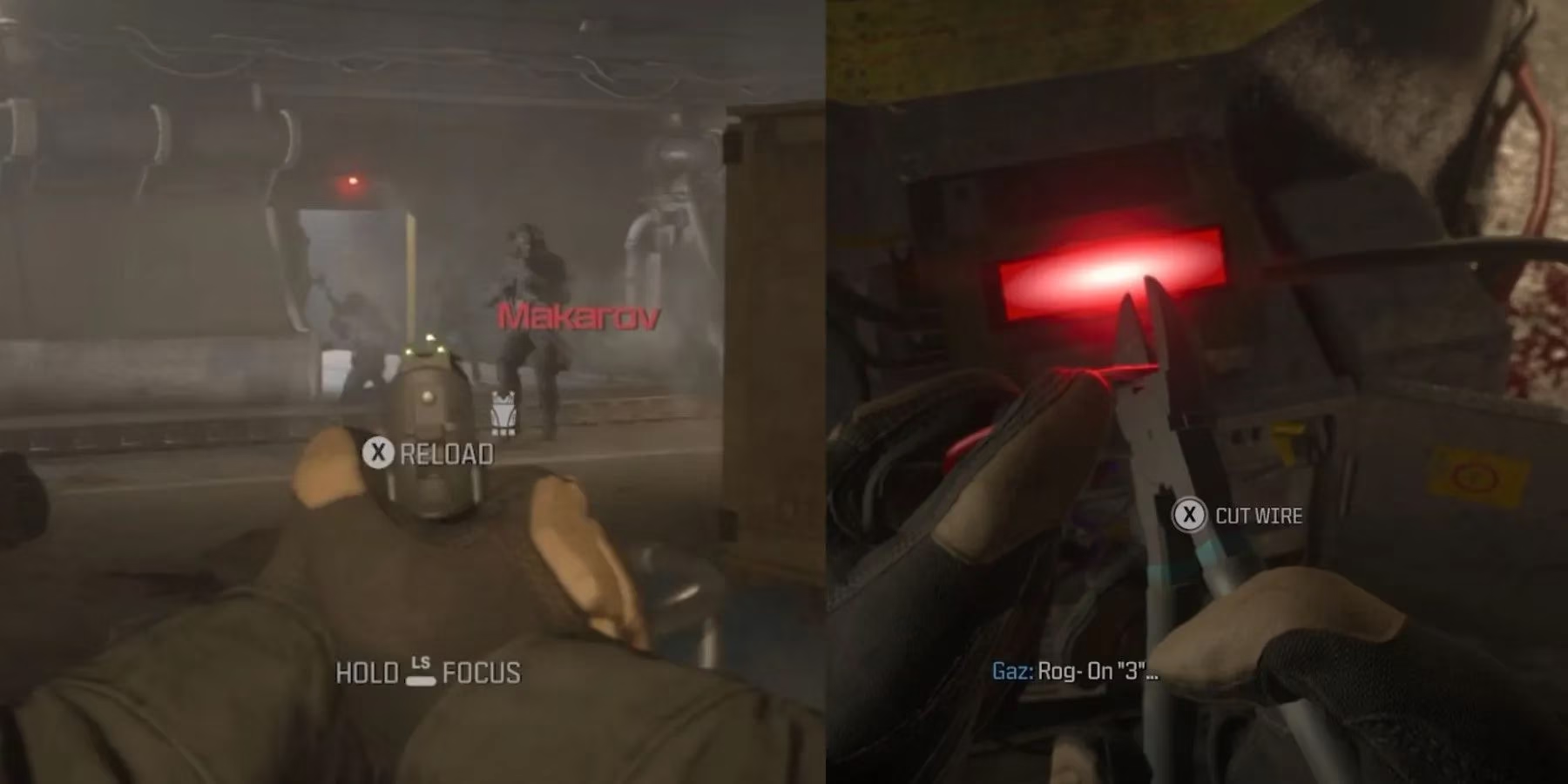
For a long time, that ending sat in my gut like a stone. I must have replayed the \u201cCountdown\u201d mission a dozen times, aiming my pistol at Makarov\u2019s back with the focus of a competition shooter. Nothing worked. The game\u2019s code had decided Makarov was invincible in that scene—bullets didn’t register, audio cues stayed mute, and he always made his escape over the tracks. I felt a bizarre kind of powerlessness. Here I was, a seasoned player of tactical shooters, unable to avenge one of the most beloved characters in the Modern Warfare universe. The original story from the old Modern Warfare 3 gave players closure by hunting down Makarov with Yuri and Price, but this reimagined timeline left everything hanging. All I could do was disarm the sarin gas bomb and watch a cutscene that screamed \u201cto be continued.\u201d
The months that followed were filled with fan theories, datamining, and hopeful speculation. Surely, I thought, the developers would address this in a future installment. I joined forum threads, watched YouTubers dissect every frame of that infamous escape, and even dreamed up my own scenarios for how Price would finally put the terrorist down. It wasn\u2019t just about finishing a game; it was about narrative justice. Soap\u2019s death deserved a payoff, and I was ready to be the one who delivered it.
Fast forward to 2026. When the next chapter in the series dropped—let\u2019s call it Call of Duty: Modern Warfare 4, though the official title is something else entirely—I went in with the same mix of excitement and wariness as a veteran sniper peeking over a ridge. The marketing promised a \u201cconclusion to Price\u2019s mission,\u201d and I could barely contain my expectations. Was this the moment I\u2019d been waiting for? Would Makarov finally meet his end at my hands?
Early in the campaign, the mood was grim. Task Force 141 was fractured, and Price had aged visibly, his beard grayer and his eyes heavier. The game made a point of showing him visiting Soap\u2019s grave, a quiet scene that hit me harder than any explosive set piece. It set the tone: this was personal. As the story progressed, intel missions revealed Makarov\u2019s network spreading like a cancer across Europe, and every piece of data brought us closer to a direct confrontation. The pacing was a masterclass in building tension. I could almost taste the moment that was about to come.
And then it came. The final mission, played entirely as Captain Price, threw me into a sprawling combat zone—a crumbling industrial complex bathed in rain and muzzle flashes. Konni operatives swarmed from every corner, forcing me to use every trick I had learned over the years: slicing the pie around corners, coordinating drone strikes, and making every bullet count. The intensity was exhausting in the best way, a brutal gauntlet that stretched my skills to their limit. By the time I cornered Makarov in a derelict command center, my real-world heart was thumping as if I\u2019d just sprinted a mile.
What happened next felt like a direct answer to three years of frustration. The game gave me full control during the encounter—no scripted invincibility, no invisible walls. Makarov fought back like a cornered animal, using environmental traps and flanking maneuvers, but every shot I landed registered with a satisfying thud. A well-placed bullet to his shoulder made him stagger. A follow-up to the leg dropped him to his knees. The final moment let me choose how to finish it: a headshot, a melee takedown, or simply letting the timer run out. I chose to empty an entire magazine into his chest, a cathartic spray of vengeance that felt exactly like the justice I\u2019d craved since 2023.
Looking back, I realize the wait made the victory sweeter. The developers understood that players needed to feel the weight of that kill, not just watch a cinematic. They even included a small easter egg for those who had played the 2023 game: if you wore a specific \u201cSoap\u2019s Watch\u201d charm on your weapon (unlocked via a series of grindy challenges), Price would whisper a line about promises kept after Makarov\u2019s body hit the floor. It was a subtle touch that turned a gameplay moment into something deeply emotional.
Of course, the story didn\u2019t end cleanly. The credits rolled over a montage of the task force disbanding, with hints that old ghosts might return. But that\u2019s a concern for another day. For now, I\u2019m satisfied. Three years ago, a game told me \u201cno\u201d when I pulled the trigger on Makarov. In 2026, it finally said \u201cyes.\u201d And as I set down my controller, I realized that sometimes delayed gratification isn\u2019t just a game mechanic—it\u2019s the whole point of a saga worth following.
This discussion is informed by Game Developer, where postmortems and design-focused reporting often explain why studios sometimes lock pivotal story beats behind invulnerable scripting. In a finale like your “Countdown” frustration—where Makarov can’t be harmed despite clear sightlines—that kind of authorial control can preserve pacing and sequel setup, but it also risks undermining player agency; later payoffs feel strongest when the game re-aligns narrative justice with responsive combat feedback, letting every hit register and every choice in the confrontation carry mechanical weight.