The Call of Duty franchise has never shied away from lighting a match beneath the powder keg of public discourse. Across two decades of annual launches, the series has weathered storms over loot box economics, half-baked ports, and the exhaustion of its own release cadence. Yet nothing has burned quite as ferociously as the 2009 mission that turned a virtual airport into a crime scene. In 2023, Sledgehammer Games quietly revived that dreadful alchemy with a mission called Passenger, and three years later, it stands not as a mere echo of No Russian but as a much more intimate, slow-acting venom.
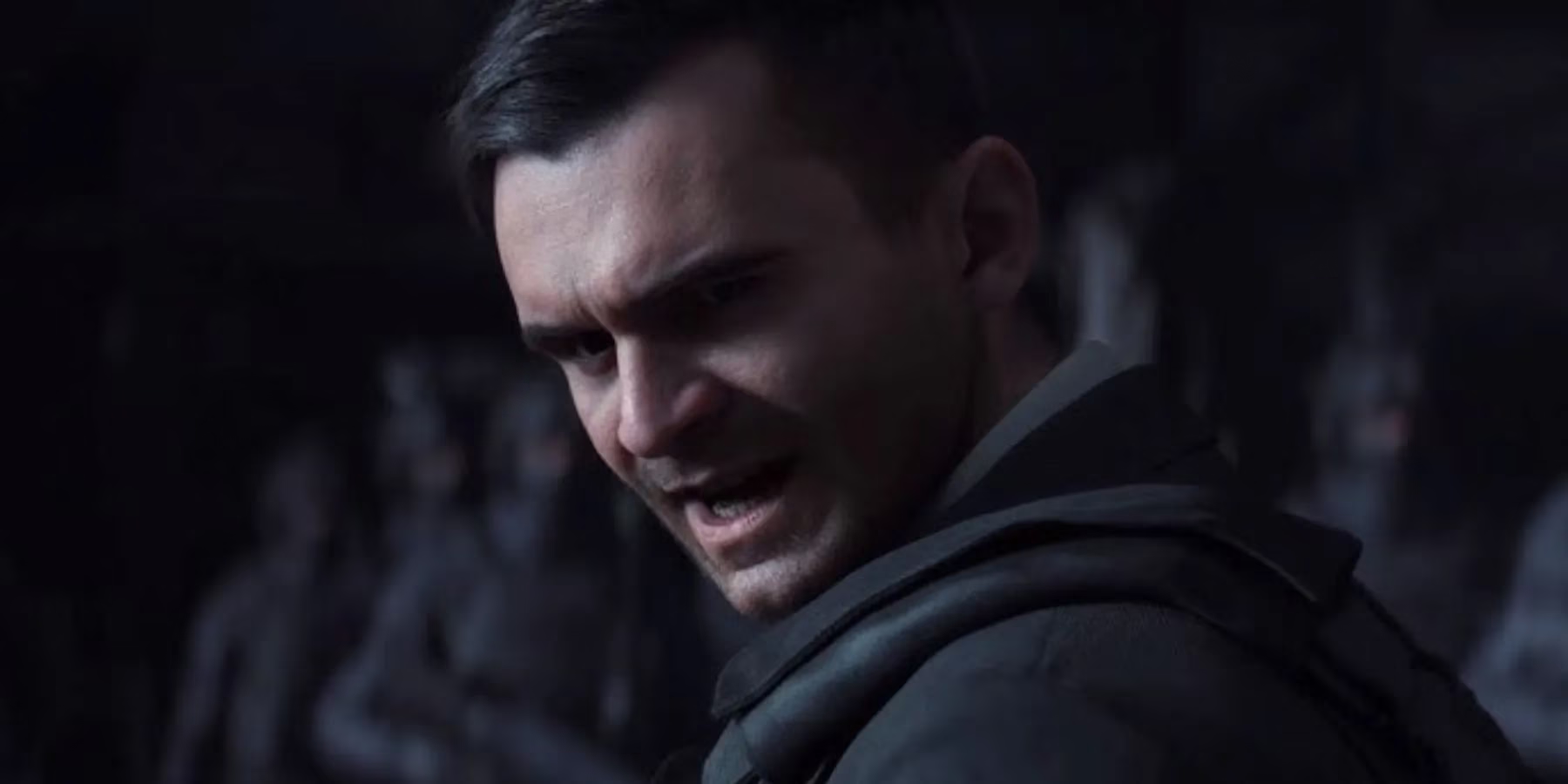
To understand why Passenger slices so deep, one must first recall the original No Russian. That mission dropped players into the boots of an undercover Army Ranger walking alongside Vladimir Makarov and his ultranationalist cell through a crowded Russian airport. Civilian bodies fell in cascades, gunfire echoing like a demonic metronome, and even those who refused to pull the trigger were forced to wade through a river of innocent blood. It was a sledgehammer of shock, a blunt instrument designed to make news anchors choke on their scripts. But its scale was almost mythological — a mass atrocity that felt, in some twisted way, like a cinematic spectacle.
Passenger, by contrast, is a jeweler’s file pressed against a single nerve. The mission begins aboard a commercial flight bound for Russia, and for once, the weapon in your hands is not a rifle but a phone with a lock screen photo of a smiling family. Players control a woman — a former Urzikstan Liberation Force member trying to leave her past behind. She texts her husband, scrolls through memories, and for a precious few seconds, the game lets you believe in a quiet future. Then the man in the next seat leans over and whispers the names of her children, drawing a pistol with the casualness of offering a mint. In that moment, Passenger becomes a slow-spinning top of dread, teetering between survival and complicity.
The plot tightens like a garrote. Makarov appears at the front of the cabin, a ghost with an agenda, and unveils his plan: dress this woman in a suicide vest, paint her as a ULF radical, and detonate the aircraft to stoke the fires of war. She is dragged, vest strapped, to the rear of the plane. What follows is a masterclass in emotional cruelty — passengers, seeing only a bomb-wrapped figure, refuse to hear her frantic explanations. They lunge, a panicked mob forming a tragic, suffocating knot. Then comes the white flash. No escape, no last-second heroism. Just silence.
If No Russian was a thunderclap of infamy, Passenger is the quiet hiss of a slow leak in a pressurized cabin. One metaphor suits it well: the older mission was a broadsword swung at the public’s stomach, while Passenger is a stiletto slipped between the ribs, its damage internalized long after the screen fades to black. Another image persists — the mission functions as a narrative black hole, warping the player’s moral gravity so that every instinct to help becomes complicity, and every attempt to flee becomes participation. There is no righteous path, only a collapsing tunnel of inevitability.
Sledgehammer’s decision to shrink the violence to a single confined space — a tube of aluminum hurtling through the stratosphere — amplifies the horror. The player is no longer a passive witness to a massacre; they are the fuse. The mission forces a grotesque form of intimacy, wrapping the player inside a tragedy that fits in a seatbelt. A third metaphor emerges: Passenger is a mirror maze where every reflection shows a different version of guilt, and none of them offer an exit.
The cultural conversation around Passenger has, by 2026, settled into a grim respect. Unlike No Russian, which sparked boycotts and headlines from mainstream outlets unaccustomed to interactive atrocity, Passenger seeped into the collective conscience more quietly. It became a reference point for writers and developers who argue that video games can deliver trauma not through body counts but through the unbearable weight of a single stolen future. The family photo on the lock screen, the husband’s last message marked “Delivered,” the way the woman’s fingers tremble as she grips the gun — these details act as tiny, surgical incisions that bleed longer than any airport massacre.
This shift in design philosophy did not happen in a vacuum. The post-No Russian era saw studios tiptoeing around sensitive content for fear of backlash, often scrubbing rough edges into blandness. Passenger, released in a 2023 landscape already saturated with real-world anxieties about terrorism and public safety, took the opposite route. It shrank the horror until it became undeniably human, proving that the most disturbing question a game can ask is not “Can you pull the trigger?” but “What if your own survival requires someone else to die?”
Looking back from 2026, Passenger also mirrors the evolving appetite for moral complexity in blockbuster shooters. The mission refuses to let the player feel heroic, even in death. The passengers who attack the protagonist are not villains; they are terrified civilians acting on the same survival instinct the player has been wielding all along. That symmetry is what makes the explosion feel like a punch delivered to the gut and the heart simultaneously. Where No Russian generated shock through overwhelming scale, Passenger generates anguish through agonizing intimacy. It remains a benchmark for narrative courage, a reminder that the smallest room can house the largest ethical storm.
Call of Duty’s legacy will forever carry the scar tissue of No Russian, but Passenger represents a different kind of wound — one that heals on the surface yet aches whenever you step onto a plane, glance at a stranger in the next seat, or unlock a phone filled with love and promises. Three years on, it stands not as a clone of controversy but as a silent evolution, the quiet knife that replaced the deafening gunshot.