The annual pilgrimage through the digital battlegrounds of Call of Duty has, in recent years, felt less like a march of progress and more like a haunting echo. The announcement of Call of Duty: Modern Warfare 3 was met not with a unified roar of anticipation, but with a weary sigh from a community fragmented by expectation and disillusionment. For a fleeting moment, whispers of a year of silence, a year of recalibration and renewal, offered a tantalizing glimmer of hope. Yet, the relentless machinery of tradition ground on, delivering another title onto the precipice of familiar critique. Initial impressions painted it as a mere expansion, a vessel for recycled content, lacking the fresh cartography of original 6v6 domains. Yet, from within this cycle of skepticism, a new mechanic emerged during the beta—a slender reed of potential named Tac-Stance, offering a fragile promise to shatter a decade-long pattern of abandoned innovation.
For two decades, the Call of Duty franchise has been a titan, its shadow cast long over the first-person shooter landscape. Yet, for much of the last decade, that shadow has been criticized for its stagnant shape. The developer's conundrum is a poetic tragedy: the community, a chorus of millions, sings in dissonant harmony. When the architects dare to remodel the foundation with new mechanics, they are met with calls for a 'return to form,' a nostalgic retreat to hallowed, simpler grounds. Conversely, when the blueprints remain unchanged, the lament rises for perpetual repetition, for purchasing the same soul in a new skin each autumn. This impossible ballet of pleasing the fickle muse of mass appeal has birthed one of the franchise's most melancholic rhythms: the swift and silent burial of novel ideas.
This ephemeral nature of innovation has become a sorrowful hallmark. Features introduced with fanfare one year vanish into the ether by the next, their tombstones littering the franchise's history:
-
A Co-operative Dream: Call of Duty: Ghosts' Extinction mode, a bold foray into narrative-driven PvE survival, was left behind in the alien dust.
-
A Social Hub: Call of Duty: WWII's Headquarters, a vibrant, living lobby meant to foster community, was dismantled and forgotten.
-
A Strategic Theater: The same title's War mode, a objective-based, linear battle experience, faded from the regular rotation.
-
A Fluid Motion: Advanced Warfare's speed reload, a nuanced mechanical tweak, was discarded in the exosuit's wake.
These are but a few spectral echoes of what could have been, each a testament to a philosophy that values immediate, universal acclaim over cultivated, evolving gameplay. Interestingly, the studio often caught in the crossfire of this trend is Sledgehammer Games. Their entries have frequently been the ones to wield the chisel of change, introducing experimental modes and mechanics. Consequently, they have also borne witness to the most severance of their creations in subsequent annual iterations. The wheel of fortune has turned once more, placing Sledgehammer at the helm of Modern Warfare 3, presenting a poignant opportunity for redemption, to finally nurture a sapling of change into a lasting tree.
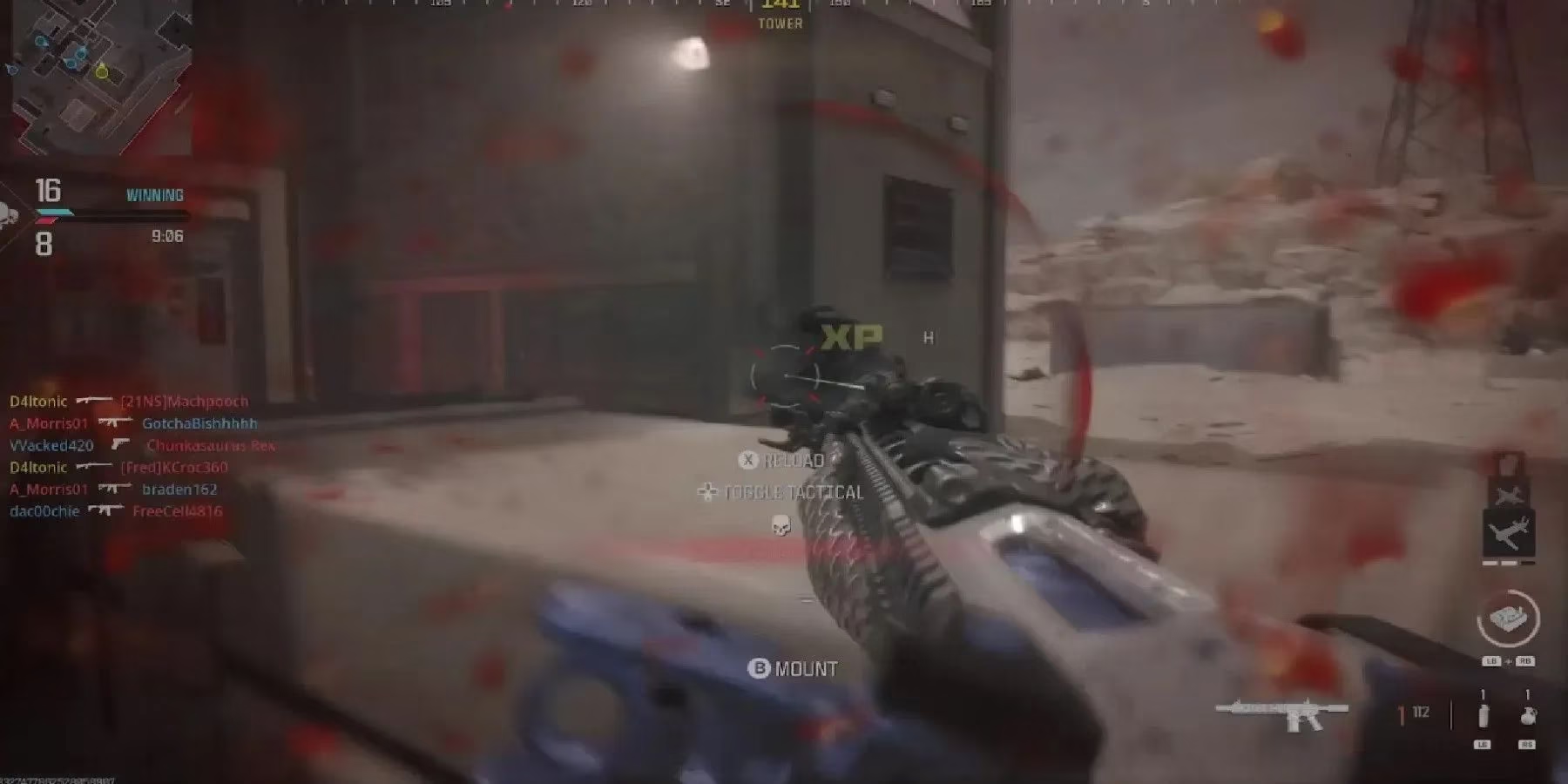
Enter Tac-Stance, the potential harbinger of a new dawn. This is not merely another attachment or perk; it is a fundamental reimagining of the combat stance itself. By a deft combination of inputs—holding the aim trigger while pressing a directional command—players slip into this hybrid posture. It exists in the liminal space between the deliberate precision of Aiming Down Sights (ADS) and the chaotic freedom of hip-fire. The tactical advantages are immediately palpable:
| Aspect | Tac-Stance Effect |
|---|---|
| Mobility | Increased movement speed compared to full ADS 🏃♂️ |
| Accuracy | Enhanced bullet spread control versus standard hip-fire 🎯 |
| Flexibility | A rapid-response option for close-to-mid-range engagements ⚡ |
The poetry of this mechanic lies in its integration. It does not seek to replace the foundational pillars of Call of Duty combat but to weave a new thread between them. It rewards situational awareness and aggressive, fluid playstyles, offering a tangible tool for navigating the deadly ballet of multiplayer maps. Early receptions from the beta battlefield have been cautiously optimistic, with many heralding it as a genuinely fresh layer of strategic depth. While balance passes will undoubtedly be necessary post-launch, the seed has been planted.
As Call of Duty: Modern Warfare 3 stands on the launchpad, its fate is intertwined with this single innovation. Will Tac-Stance suffer the same ephemeral fate as its spectral predecessors, praised one year and purged the next? Or will it finally be the mechanic that endures, that proves a novel idea can be given time to breathe, to be refined, and to become a permanent fixture in the armory? There is a fitting symmetry in Sledgehammer Games, so often the agent of forsaken change, potentially becoming the architect of a lasting revolution. In the Tac-Stance, players see not just a new way to aim, but a fragile hope—a chance for the franchise to break its own cyclical narrative and build upon its innovations rather than burying them. The stage is set for November; the community watches, hopeful that this time, the new dawn will not fade with the next annual sunset.