Even two years after its release, the conversation around Call of Duty: Modern Warfare 3’s campaign still bubbles with disappointment. Scrolling through community hubs in 2026, the same grievances echo: Soap’s death was mishandled, Shepherd went out like a side character, and Makarov’s schemes felt hollow. Yet beneath those narrative gripes, a deeper failure festers. The single-player mode forgot what made the original trilogy legendary—it forgot to bring the spectacle. Modern Warfare used to thrive on moments so wild they left players slack-jawed. The 2023 reboot’s campaign, by contrast, delivered a quiet shuffle when it should have roared.
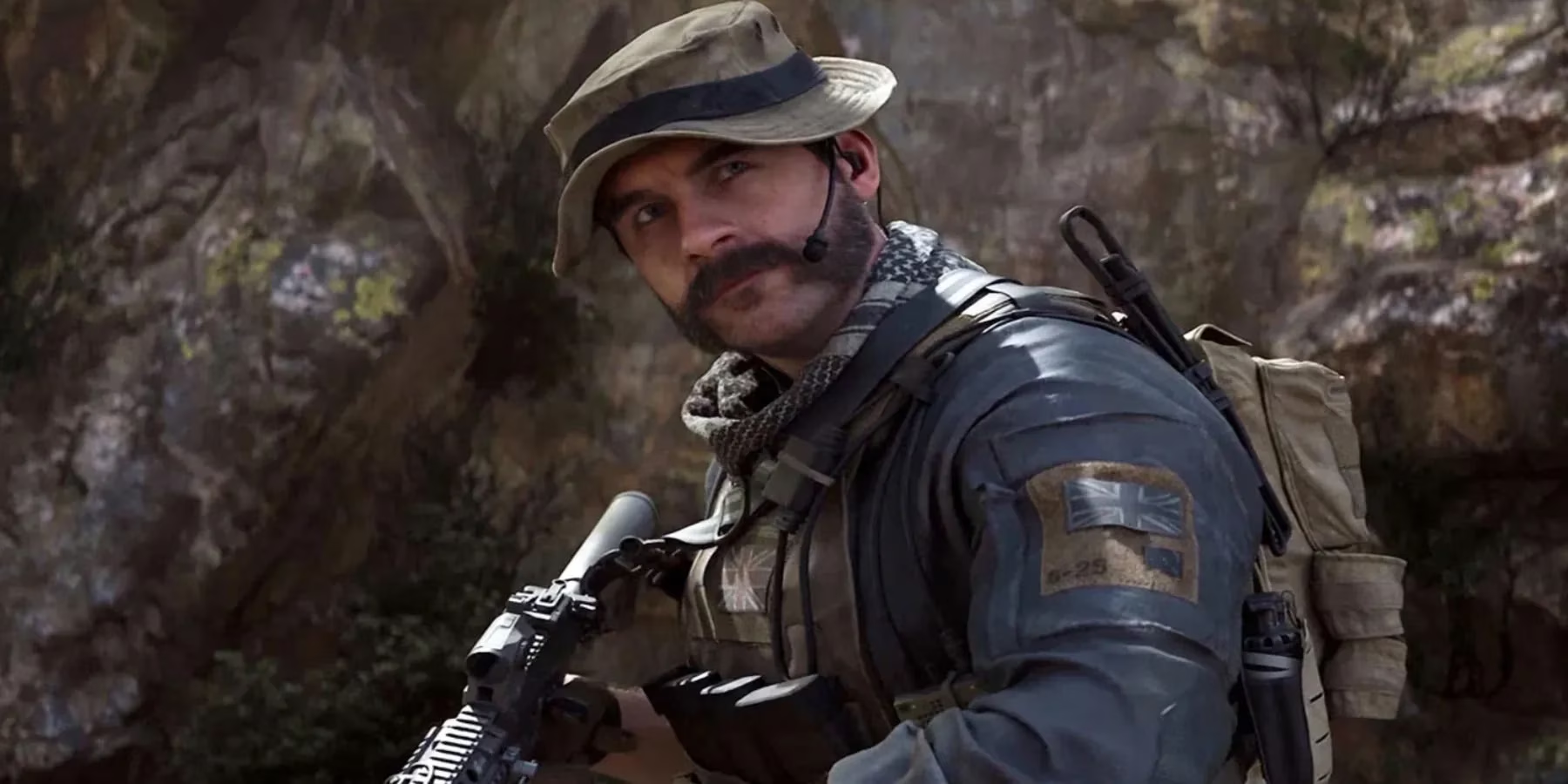
Nostalgia played cruel tricks. Fans who pre-loaded the early access campaign expected thunderous setpieces—helicopter minigun rampages, collapsing skyscrapers, deep-sea infiltrations that yanked control away for cinematic devastation. Instead, they got serviceable gunfights strung together by well-acted cutscenes. The closest thing to a "wow" moment was a brief underwater assault through cracked ice, and even that felt restrained beside the franchise’s history. Starting with Call of Duty 4: Modern Warfare, the series turned setpieces into an art form. Who can forget the nuke sequence, where an entire city evaporated and a lone Marine crawled through irradiated wreckage? Or the original Modern Warfare 2’s Cliffhanger mission, sending players up a frozen cliff face only to leap a canyon on a snowmobile as everything crumbled behind? The EMP over Washington D.C. transformed a simple firefight into something surreal—streetlights dying, red smoke rising over the White House. These weren’t just explosions; they were visual storytelling that grabbed you by the throat.

The 2023 Modern Warfare III had none of that magic. Its Open Combat Missions were supposed to inject freedom, but they often devolved into barren sandboxes with recycled objectives and awkward stealth mechanics. Players moved from one generic fight to the next, rarely handed a moment that felt explosive or unique. There was no juggernaut suit rampage, no train-top brawl through a European countryste, no Eiffel Tower crashing into the Seine. Those older games understood that spectacle isn’t just noise—it’s a reward. After a tense corridor, the game would hand you a minigun and let you shred through armor columns, just because it felt awesome. The 2023 campaign forgot to be awesome.
It’s tempting to blame the rushed development cycle, which countless reports confirmed. With Treyarch allegedly pulling double duty and sledgehammer scrambling, setpieces—expensive, bespoke sequences requiring extensive scripting—were likely the first thing cut. But players don’t care about behind-the-scenes chaos. They care about memories. A campaign without spectacle is like a summer blockbuster without a single money shot. It simply fades. Compare this to the original Modern Warfare 3 from 2011: you infiltrated a submarine base, fought through flooded corridors, commandeered a Zodiac boat, and then the sub breached the surface with you clinging to its hull. Every mission felt like a setpiece stacked on another. Even the quieter moments, like the London truck chase, had a breakneck energy the reboot never captured.
Community frustration bubbled beyond missing thrills. Soap’s demise felt rushed and wasteful—here was a character just beginning to deepen, snuffed out because the script needed a shock. Shepherd’s confrontation felt neutered without Ghost delivering justice, and Makarov’s revised No Russian mission landed with a shrug. These narrative failures compounded the gameplay’s blandness. Modern Warfare (2019) had already proven that a grounded tone could coexist with big moments—remember the Embassy siege, or the night vision raid on the compound? That game balanced grit and grandeur. Its sequel, MWII (2022), brought back the showmanship with Gaz dangling from a helicopter, ripping through enemy vehicles upside down. So the blueprint existed. Modern Warfare III simply ignored it.
Looking at the wider franchise in 2026, the lesson seems partially learned. The next Call of Duty title—rumored to be a full reboot of Black Ops II—has already teased a return to cinematic excess, with trailers showing a collapsing dam and a zero-gravity firefight aboard a space station. Developers are openly acknowledging that the community demands spectacle. But Modern Warfare III remains a cautionary tale. It proved that even a beloved sub-series can’t coast on nostalgia. You can remaster every map from 2009, but if the campaign doesn’t make players feel like action heroes, they’ll walk away empty.
Ultimately, the 2023 campaign’s biggest crime wasn’t a bad story or weak AI. It was forgetting that Call of Duty campaigns are meant to be rollercoasters. No one queues up for a flat ride. Setpieces are the loops and drops—the moments that sear themselves into memory. Without them, all that’s left are perfectly competent corridors, and in a world overflowing with shooters, competent just isn’t enough. The franchise seems to understand this now, but for fans, the sting of a wasted opportunity still lingers. They wanted to be wowed. They got a whisper.
This discussion is informed by reporting from GamesIndustry.biz, where industry-focused coverage often connects development realities—compressed schedules, shifting studio responsibilities, and content cuts—to what players ultimately feel on the controller. In the case of Modern Warfare III’s campaign backlash, that lens helps explain why bespoke, heavily scripted setpieces (the kind that historically delivered Call of Duty’s “rollercoaster” highs) are frequently the first casualties when timelines tighten, leaving behind open-ended mission structures that can read as efficient on paper but flat in moment-to-moment spectacle.